9 Refrigerator Organization Ideas to Help You Stop Forgetting Food
You buy fresh groceries with good intentions. A few days later, the leftovers are behind a carton, the spinach has disappeared into a drawer, and you’re buying another tub of something you already own.
Your refrigerator needs a system you can still use when you’re tired, hungry, and putting groceries away in a hurry.
These refrigerator organization ideas focus on making food easier to see, reach, and remember. Start with the containers you already have, then add an organizer only where it solves a specific problem.
This article contains affiliate links. If you purchase through these links, Eco Home Edit may earn a commission at no extra cost to you.
1. Create an “Eat First” Spot You Can’t Miss
Give food that needs attention a predictable home near the front of a shelf.
Use this spot for a dated container of leftovers or an opened refrigerated item you plan to finish soon. A small tray works, but a simple shelf label works too.
Keep the area compact. If everything goes into the “eat first” section, nothing stands out. Check it before deciding what to eat.
Try this today: Move one safely stored leftover into view and decide when you’ll eat it. Keep raw meat separate from this ready-to-eat area.
An “eat first” label is a reminder, not permission to keep questionable food longer. You cannot determine food safety by smell or appearance alone. FDA food-storage guidance
2. Use Clear Bins Where Small Items Get Lost
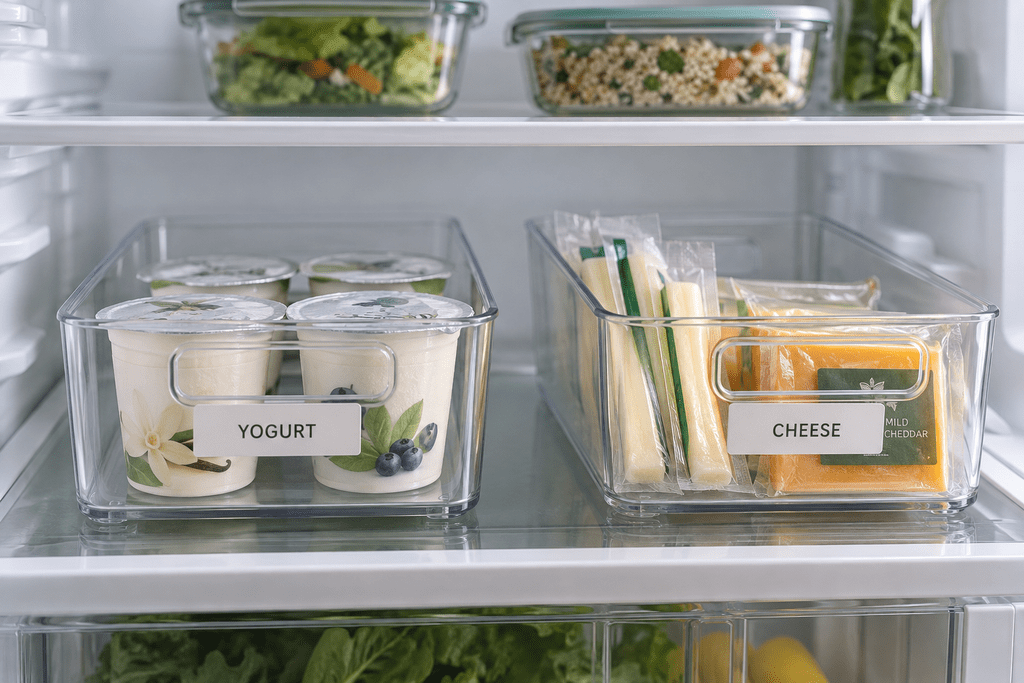
A yogurt cup tucked behind three jars is easy to miss. Grouping small packaged items in a bin gives them one place to return to.
Choose a category that actually causes trouble in your fridge: snack cups, cheese packages, or small breakfast items. Start with one bin and see whether it makes your routine easier.
The clear refrigerator organizer bins with handles are a six-pack option for grouping items and pulling them forward.
Before buying, measure your shelf’s usable width, depth, and height. Allow room to grip the handle and remove the bin without rearranging everything around it.
Skip the bin when it adds another obstacle. Large cartons may be easier to reach directly on the shelf, and you don’t need to fill every shelf with matching organizers.
3. Make Leftovers Easy to Identify
Mystery containers turn lunch into a guessing game. Use clear food-storage containers and place the contents label where you can read it without lifting the lid.
The KOMUEE glass food-storage containers with lids include ten 30-ounce containers with matching snap-lock lids. This set may suit a household that regularly packs lunches or portions leftovers.
Ten containers are more than everyone needs. If your current containers close securely and work well, keep using them.
For cooling, divide leftovers into shallow portions and refrigerate promptly. Perishable food should be refrigerated within two hours, or one hour when temperatures exceed 90°F. FoodSafety.gov food-handling guidance
Product care: Remove the KOMUEE plastic lids before microwave or oven use and follow the supplied care instructions.
4. Label Food With the Name and Date
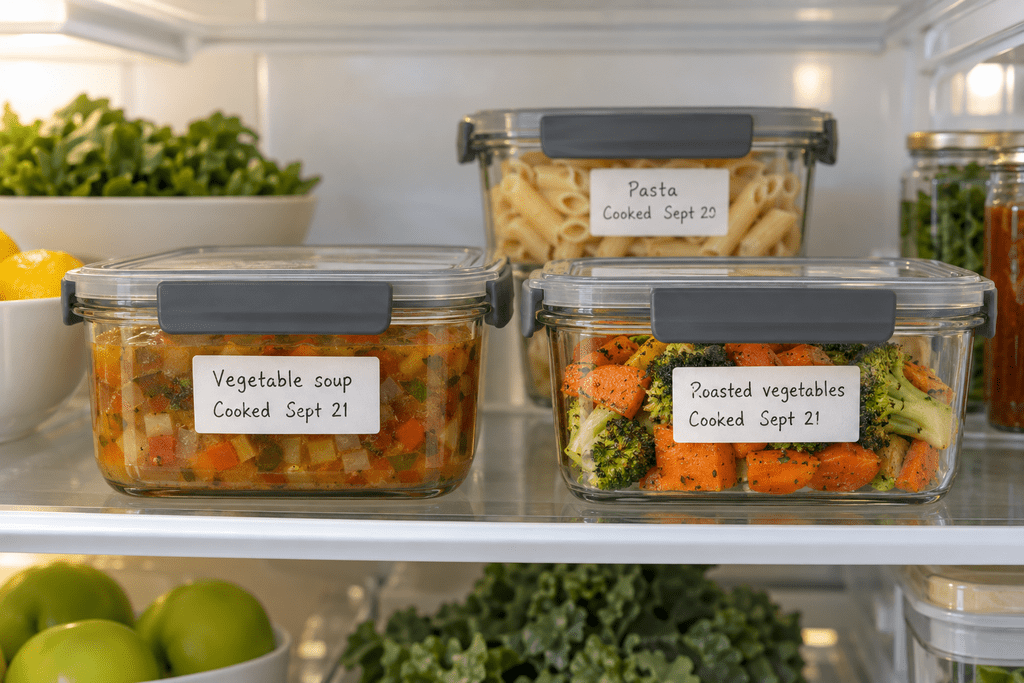
“Was this cooked yesterday or earlier this week?” is a question a simple label can answer.
Write the food name and the date you cooked it. For an opened packaged item, record the opening date and keep its storage instructions.
For example:
Vegetable soup — cooked September 21
The dissolvable food-date labels are an option for this routine. The linked roll contains 1,000 labels, so consider whether that quantity makes sense for your household. Suitable removable tape you already own may be enough.
Face labels toward the front of the shelf. If you stack containers, put the label on the side where it stays visible.
For timing, FoodSafety.gov lists three to four refrigerated days for soups, stews, and cooked meat or poultry leftovers at 40°F or below. Check its chart for the particular food you’re storing. Cold Food Storage Chart
5. Give Each Food Group a Consistent Home
Make it easy for everyone to answer, “Where does this go?”
Choose a few broad categories, such as leftovers, breakfast foods, snacks, and condiments. You don’t need a separate container or elaborate label for every ingredient.
Keep food safety ahead of convenience: contain raw meat, poultry, and seafood in sealed, leakproof packaging or containers, separate from ready-to-eat foods. Keep eggs in their original carton in the main compartment. FoodSafety.gov guidance on separating foods
Use your refrigerator’s designated compartments and consult its manual for layout guidance.
Make the system easy to follow: Show your household where the categories belong. If someone has to move four things to put one item away, simplify that section.
6. Keep Older Items in Front of New Ones
When you unpack groceries, resist putting the new package directly in front of the opened one.
Within each category, move the item that needs using sooner forward. Place newer supplies behind it when their storage dates allow.
This is especially useful for foods you buy repeatedly. Instead of opening a second package automatically, the already-open package becomes the easiest one to reach.
Keep the original labels and dates visible. Avoid combining old and new food in one container, which makes it harder to track what’s inside.
Try a simple household rule: Check for an open package before opening another.
7. Leave Breathing Room Between Organizers
A refrigerator packed with bins can still be difficult to use.
Leave enough space to see what’s there, pull containers out, and return them easily. Keep air vents clear according to your appliance’s instructions. The FDA advises against packing refrigerated food so tightly that cold air cannot circulate. FDA refrigerator guidance
Before adding another organizer, ask what is causing the crowding. It may be an oversized container, duplicate purchases, or a shelf position that doesn’t suit your groceries.
A useful test: Can you retrieve tonight’s leftovers without first unloading the shelf? If not, rearrange that area before buying more storage.
8. Check the Temperature Along With the Layout
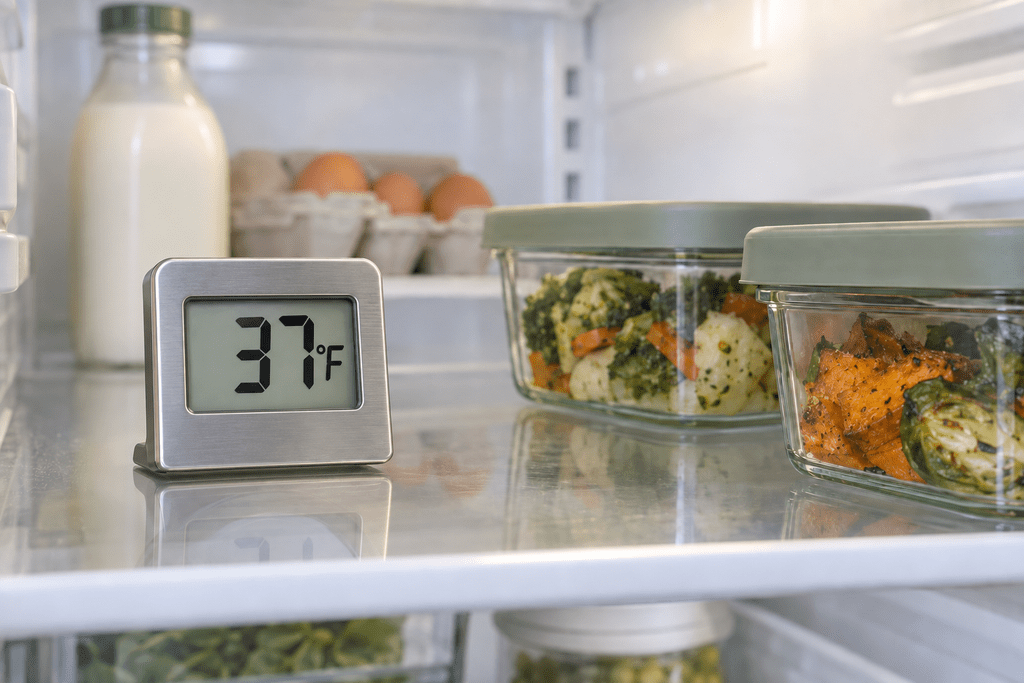
A neat refrigerator still needs to keep food cold enough.
The FDA recommends 40°F (4°C) or below for the refrigerator and 0°F (-18°C) for the freezer. An appliance thermometer lets you check the temperature rather than relying only on a numbered control dial. FDA temperature guidance
The refrigerator and freezer thermometer set includes four analog thermometers. Consider the pack size before purchasing; a household with one refrigerator may not need four.
Follow the thermometer’s placement instructions and position its display where you can read it easily. A thermometer helps you notice a temperature problem; it does not fix one.
9. Do a Quick Reset Before Grocery Shopping
Before writing your shopping list, open the fridge and check three places: the “eat first” spot, the produce drawers, and the back of the shelves.
Choose upcoming meals around what you can safely use, then buy the missing ingredients. The EPA recommends checking existing food before shopping and planning around what needs using up. EPA tips for preventing wasted food
Make this a short routine:
- Check dated leftovers and opened packages.
- Bring overlooked items into view.
- Note duplicates so you don’t buy more.
- Wipe up spills and return items to their places.
Check time-sensitive food between shopping trips too. A weekly reset does not mean leftovers can wait a week.
Start With One Shelf
You don’t have to reorganize the entire refrigerator today.
Start with the shelf where food disappears. Create an “eat first” spot, label the leftovers, and make room to reach them. Live with that arrangement for a few days before deciding whether a bin or new container would help.
A useful refrigerator is one that helps you answer three questions: What do I have? What needs using? What do I actually need to buy?
Save this guide for your next fridge reset, and follow Eco Home Edit on Pinterest for more practical home organization ideas.